Our Mission: Turning grey to green
Our Mission: Turning grey to green
Purpose
Rieder specializes in the manufacture of solution-oriented, eco-friendly and commercially viable concrete products. The greatest driving force behind the continuous development is the striving to create more than just sustainable concrete elements in order to allow us to make an active contribution to the energy revolution ourselves. The aim is to offer architects and builders an intelligent facade with countless possibilities in terms of aesthetics, flexibility of design, sustainability, and cost-effectiveness.

Purpose
Rieder specializes in the manufacture of solution-oriented, eco-friendly and commercially viable concrete products. The greatest driving force behind the continuous development is the striving to create more than just sustainable concrete elements in order to allow us to make an active contribution to the energy revolution ourselves. The aim is to offer architects and builders an intelligent facade with countless possibilities in terms of aesthetics, flexibility of design, sustainability, and cost-effectiveness.


Responsibility
Responsibility
"The construction sector not only has the potential to make changes, it has a duty to do so. I don’t want to be accused of our generation being responsible for destroying our planet Earth. I could never forgive myself for not doing something de-spite my better knowledge. We have analysed our sustainability performance and worked out the CO₂ footprint of our company in order to identify important levers for a climate strategy. Now we are implementing our plan, evaluating the results and developing them further,” says Wolfgang Rieder, summarising the timetable of his company’s expedition towards climate neutrality.
"The construction sector not only has the potential to make changes, it has a duty to do so. I don’t want to be accused of our generation being responsible for destroying our planet Earth. I could never forgive myself for not doing something de-spite my better knowledge. We have analysed our sustainability performance and worked out the CO₂ footprint of our company in order to identify important levers for a climate strategy. Now we are implementing our plan, evaluating the results and developing them further,” says Wolfgang Rieder, summarising the timetable of his company’s expedition towards climate neutrality.
Reaching goals with self analysis
Reaching goals with self analysis
According to the 2019 state analysis, the company emits some 7,100 metric tons of CO₂ each year. As a result of our zero waste strategy, total CO₂ emissions in 2021 were around 4,515 metric tons. This means that to date, despite increasing output, the company has already saved 36% compared with 2019.
According to the 2019 state analysis, the company emits some 7,100 metric tons of CO₂ each year. As a result of our zero waste strategy, total CO₂ emissions in 2021 were around 4,515 metric tons. This means that to date, despite increasing output, the company has already saved 36% compared with 2019.
Our strategy
Our strategy
The three pillars of the zero-waste strategy - 1/3 substitution, 1/3 more efficient processes, 1/3 offset measures - are the driving forces to achieve the transition to a climate-positive company.
The three pillars of the zero-waste strategy - 1/3 substitution, 1/3 more efficient processes, 1/3 offset measures - are the driving forces to achieve the transition to a climate-positive company.
Substitution
Substitution

On its way to climate neutrality, Rieder developed Matrix 3.0, a CO₂-reduced material for sustainable facade elements. 50% of the conventional cement was replaced by local natural pozzolana. The rock flour, which has been used in the construction of buildings since ancient times, has excellent properties in terms of structural density and hardening. The cement substitution allows a CO₂ reduction of 30% compared with Matrix 2.2 and a reduction of 23% for the facade elements. It represents the preliminary stage to cement-free production.
On its way to climate neutrality, Rieder developed Matrix 3.0, a CO₂-reduced material for sustainable facade elements. 50% of the conventional cement was replaced by local natural pozzolana. The rock flour, which has been used in the construction of buildings since ancient times, has excellent properties in terms of structural density and hardening. The cement substitution allows a CO₂ reduction of 30% compared with Matrix 2.2 and a reduction of 23% for the facade elements. It represents the preliminary stage to cement-free production.

CO₂-emissions Rieder
Efficient processes
Efficient processes

Rieder started a new projects to reduce waste in production. A waste analysis was used over a period of more than one year to determine what percentage of the material was suitable for reuse. Over 106,000 parts were read in; areas, boundaries, shapes, colours, and textures were decoded and then classed by size and shape. The potential shapes were used to develop the pixel product, a small-format shingle measuring 147 x 240 millimetres. Due to their small size, the elements open up entirely new design options for innovative building envelopes.
Rieder started a new projects to reduce waste in production. A waste analysis was used over a period of more than one year to determine what percentage of the material was suitable for reuse. Over 106,000 parts were read in; areas, boundaries, shapes, colours, and textures were decoded and then classed by size and shape. The potential shapes were used to develop the pixel product, a small-format shingle measuring 147 x 240 millimetres. Due to their small size, the elements open up entirely new design options for innovative building envelopes.

Rieder pixel
Offset
Offset

As part of its offsetting measures, 50,000 trees have already been planted in Canada to bind CO₂. The aim is to have planted half a million trees by 2025. Rieder chose old tree varieties and grows them together with local partners. These varieties are not only more resilient, they also bind more CO₂.
As part of its offsetting measures, 50,000 trees have already been planted in Canada to bind CO₂. The aim is to have planted half a million trees by 2025. Rieder chose old tree varieties and grows them together with local partners. These varieties are not only more resilient, they also bind more CO₂.

Planting trees in Canada
Green Report
The Rieder Sustainability Report was first published in 2022 for the reporting year 2021 and is based on the GRI Standards 2021 (“with reference to”). The present edition was updated in 2025 with key figures for 2024. In addition to the continued application of the GRI Standards, the current revision also incorporates, for the first time, the requirements of the VSME reporting standard for small and medium-sized enterprises. This practice-oriented standard enables even more targeted and tailored reporting in line with the specific framework conditions of medium-sized companies. In the Green Report, the company critically assessed itself, examined various business areas in detail and focused on the headquarters in Maishofen, Austria and the production site in Kolbermoor, Germany.

Green Report
The Rieder Sustainability Report was first published in 2022 for the reporting year 2021 and is based on the GRI Standards 2021 (“with reference to”). The present edition was updated in 2025 with key figures for 2024. In addition to the continued application of the GRI Standards, the current revision also incorporates, for the first time, the requirements of the VSME reporting standard for small and medium-sized enterprises. This practice-oriented standard enables even more targeted and tailored reporting in line with the specific framework conditions of medium-sized companies. In the Green Report, the company critically assessed itself, examined various business areas in detail and focused on the headquarters in Maishofen, Austria and the production site in Kolbermoor, Germany.
Reuse & Recycle
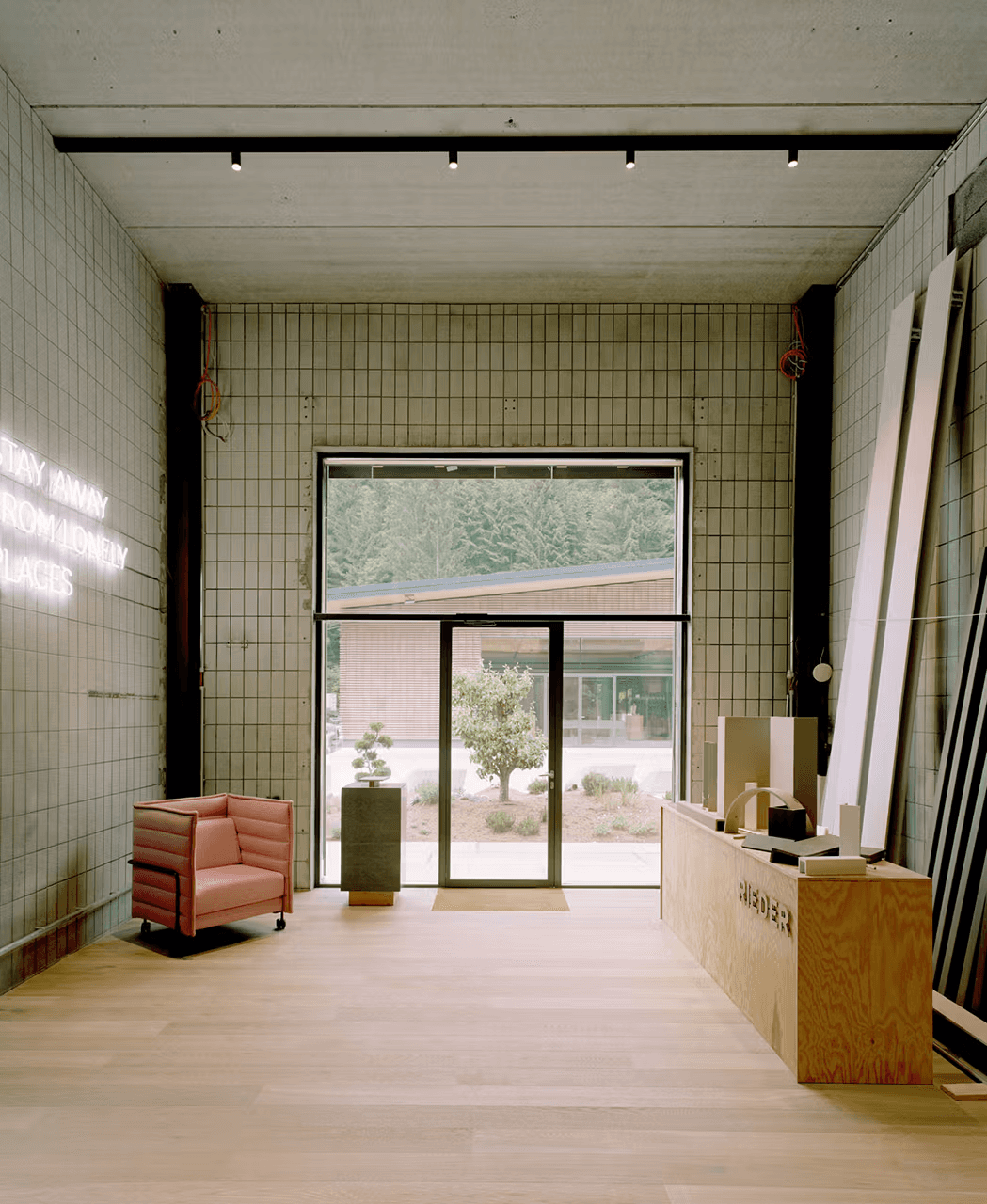
Building in the existing fabric - One example of how globally necessary changes can succeed is glemm21, the new headquarters in Maishofen, which is not strictly speaking a new building. “Using what’s there already rather than building something new is known to be the best way to save grey energy and reduce land sealing. And so, we tried it out on ourselves”, says Wolfgang Rieder.
Reuse & Recycle
Building in the existing fabric - One example of how globally necessary changes can succeed is glemm21, the new headquarters in Maishofen, which is not strictly speaking a new building. “Using what’s there already rather than building something new is known to be the best way to save grey energy and reduce land sealing. And so, we tried it out on ourselves”, says Wolfgang Rieder.


Join our team!
Join our team!
